IB TOK essay planning begins with understanding the prescribed title and building a line of inquiry. A useful plan connects claims, examples, and evaluation so that each paragraph contributes to an answer. A collection of impressive quotations or loosely related real-world examples does not provide that structure on its own.
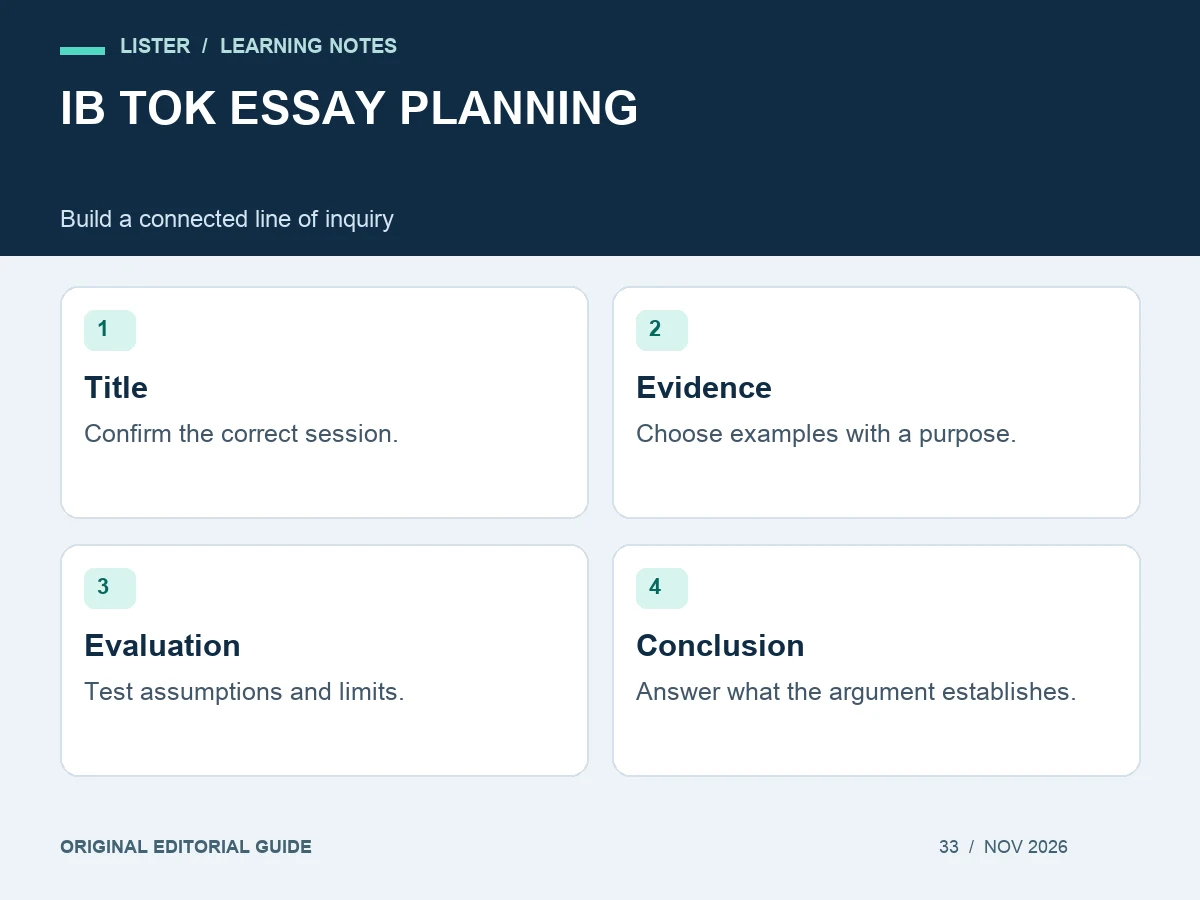
Confirm the title and assessment session
The IB describes TOK assessment as including an exhibition and a 1,600-word essay. Students choose from the prescribed titles for their assessment session. Confirm the current list and requirements with your teacher; a title from an earlier session is not interchangeable with the current options.
This guide provides a planning method. It does not supply a completed assessed essay or invent a prescribed title.
1. Unpack the wording
Underline the key terms and the relationship the title asks you to investigate. Ask what would count as answering the question and what would take the discussion away from it. Define terms in a way that helps the argument, rather than adding dictionary definitions without explaining their relevance.
Keep the exact title visible while planning. Replacing a demanding phrase with an easier, broader question can produce a fluent essay that does not address the task.
2. Choose examples for their analytical value
For each possible example, record what happened, the source you have read, and the knowledge issue it helps examine. Then ask whether the example supports, qualifies, or challenges your claim. If it only illustrates a topic without revealing anything about how knowledge is produced or evaluated, it may not earn its place.
3. Use a planning matrix
| Planning element | Question to answer |
|---|---|
| Claim | What am I arguing in relation to the title? |
| Example | What specific case helps test this claim? |
| Analysis | Why does the case support this interpretation? |
| Limitation | Under what conditions might the claim be weaker? |
| Implication | What does this mean for the title as a whole? |
These are planning prompts, not a compulsory paragraph formula. The sequence should support your reasoning rather than force every section into identical wording.
4. Evaluate rather than merely disagree
A counterclaim is useful when it tests the scope or assumptions of an argument. Simply writing “however, some people disagree” adds little. Explain what changes: the method, the kind of evidence, the purpose of the knowledge, or the context in which it is used.
As a general planning exercise, consider whether a method that is useful for predicting a pattern is equally useful for explaining an individual case. This is an illustrative analytical question, not an official prescribed title. Its value lies in identifying conditions and limits rather than forcing a universal yes or no.
5. Plan the conclusion before drafting
Write a provisional answer to the title in two sentences. Identify what your argument establishes and what remains conditional. If the conclusion does not follow from the planned sections, revise the plan before polishing the introduction.
Final planning check
- The exact title and session have been confirmed.
- Each example has a clear purpose and a traceable source.
- Analysis explains the connection between evidence and claim.
- Alternative interpretations are evaluated fairly.
- The conclusion follows from the discussion.
Use teacher feedback and the current assessment guidance to refine your work. Keep ownership of the argument, examples, and writing, and acknowledge sources appropriately throughout.
Continue learning
- International Curriculum: Choosing Subjects for University
- Perbedaan A Level dan IB: Pilih Mana Setelah IGCSE?
References checked: 4 November 2026.