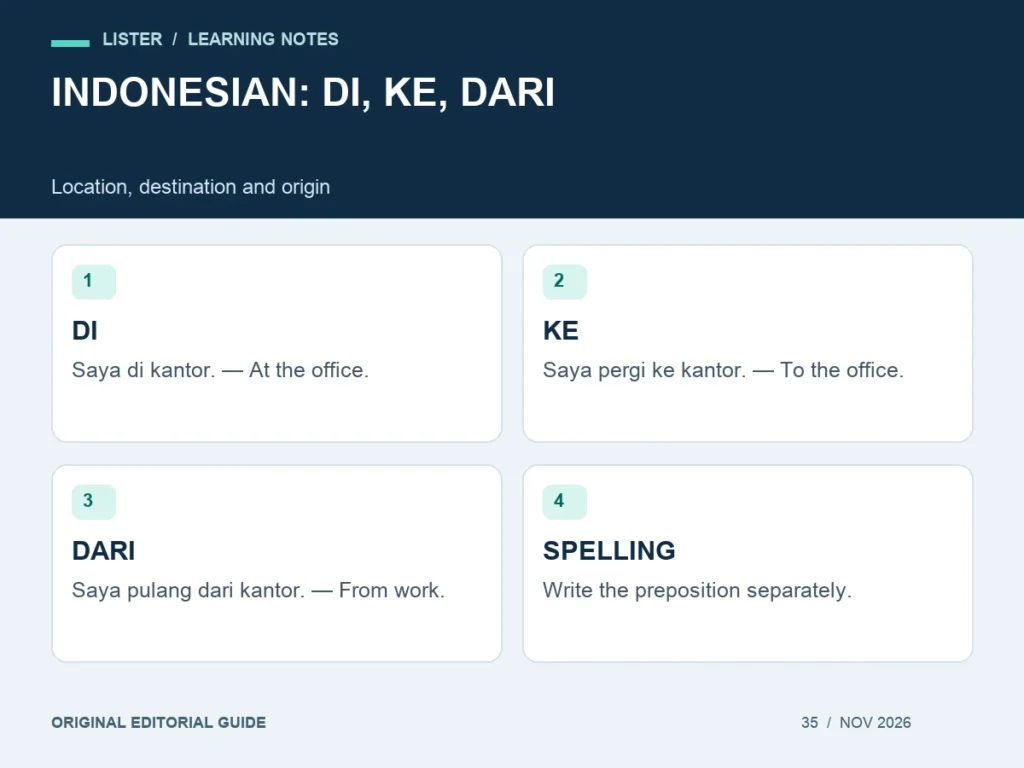
Indonesian di, ke and dari help you describe location, destination and origin. Learning them as a connected set makes everyday conversations easier: you can explain where you are, where you are going and where you have come from.
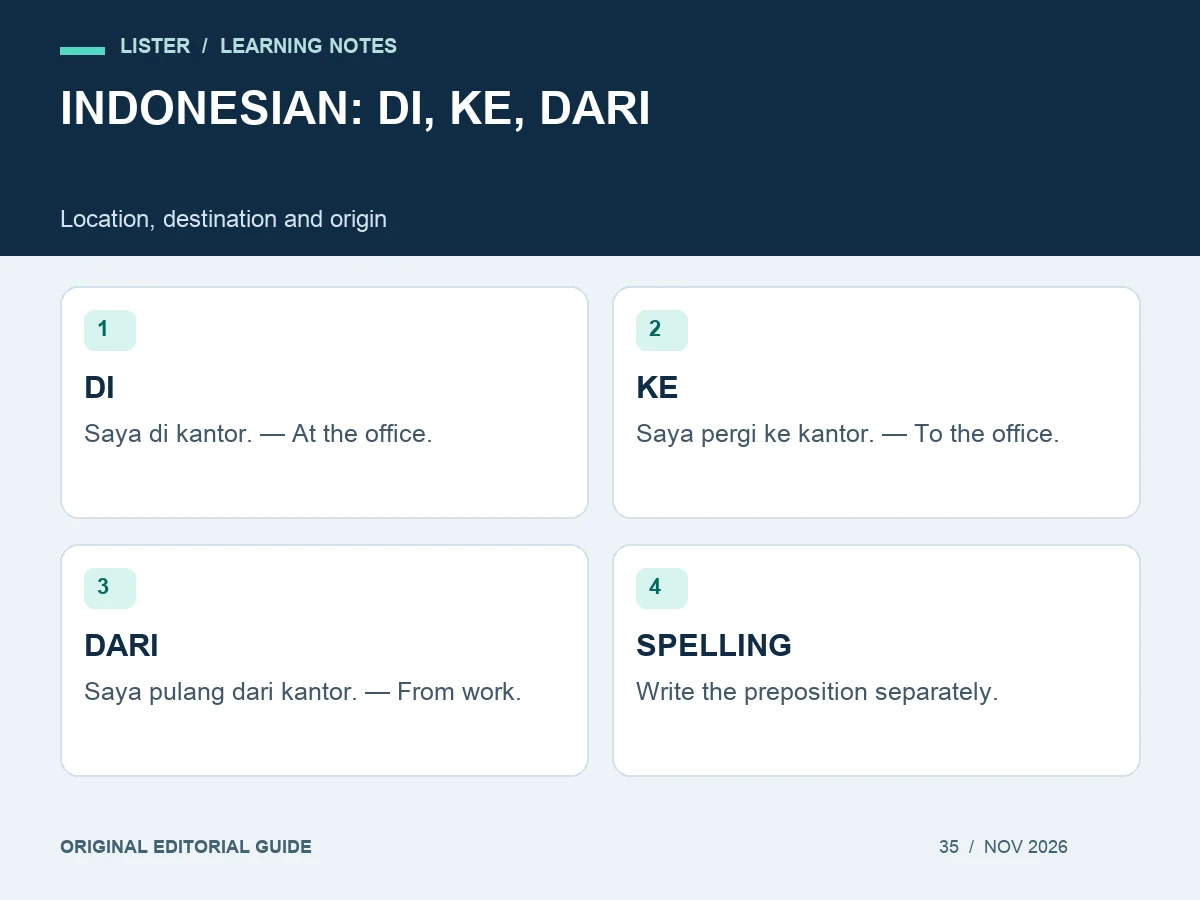
The basic distinction
| Preposition | Main use in this lesson | Example |
|---|---|---|
| di | Location: at or in | Saya di kantor. — I am at the office. |
| ke | Destination: to | Saya pergi ke kantor. — I am going to the office. |
| dari | Origin: from | Saya pulang dari kantor. — I am coming home from the office. |
The Indonesian official spelling guidance, EYD V, states that these prepositions are written separately from the following word. Write di rumah, ke sekolah and dari Jakarta, with a space.
Use di for a location
“Buku saya ada di meja” means “My book is on the table.” The word di does not always correspond to one English preposition. Depending on the location, English may use at, in or on.
For a more precise position, add a location phrase: di atas meja means on top of the table, and di depan rumah means in front of the house. Learn the whole phrase with a real object or picture.
Use ke for a destination
“Kami pergi ke perpustakaan” means “We are going to the library.” The sentence describes movement towards a destination. Compare it with “Kami ada di perpustakaan”, which describes where the speakers are.
Do not choose a preposition simply because a sentence contains a movement verb. “Saya berjalan di taman” describes walking in the park, while “Saya berjalan ke taman” describes walking to the park. The intended meaning decides the choice.
Use dari for origin
“Dia datang dari Bandung” means “They come from Bandung” in this context. Dari can also identify a starting point in a journey: “Bus berangkat dari terminal” means “The bus leaves from the terminal.” This lesson focuses on places; dari has other uses that you can learn separately.
A short conversation
A: Kamu sekarang di mana? — Where are you now?
B: Saya di kafe. — I am at a café.
A: Setelah itu, kamu mau ke mana? — Where do you want to go after that?
B: Saya mau ke toko buku. — I want to go to the bookshop.
A: Kamu tadi dari mana? — Where did you come from earlier?
B: Saya dari kampus. — I came from campus.
This conversation uses kamu, a familiar form of “you”. Your choice of address should fit the relationship and setting; a teacher can help you practise more formal alternatives.
Practice: choose di, ke or dari
- The keys are in the bag: Kunci ada ___ tas.
- We are going to Bali: Kami pergi ___ Bali.
- The train leaves from Bandung: Kereta berangkat ___ Bandung.
- I am studying at home: Saya belajar ___ rumah.
- She walks to the station: Dia berjalan ___ stasiun.
- We have just returned from the market: Kami baru pulang ___ pasar.
Answers: 1 di; 2 ke; 3 dari; 4 di; 5 ke; 6 dari. Explain each answer using location, destination or origin before checking the key.
One spelling distinction
The location preposition di is separate, but the passive verb prefix di- is attached to its verb: dibaca means read in a passive construction. Compare “Buku itu dibaca di rumah” — “The book is read at home.” The first di- belongs to the verb; the second di introduces a place.
For your next practice, describe three real places in your day: where you are, where you will go, and where you have come from. Changing the places helps you use the pattern beyond a memorised example.
Continue learning
- Learn Indonesian Online: 20 Everyday Phrases and a Simple Study Routine
- Belajar Bahasa Indonesia untuk Penutur Asing: Panduan BIPA
References checked: 4 November 2026.