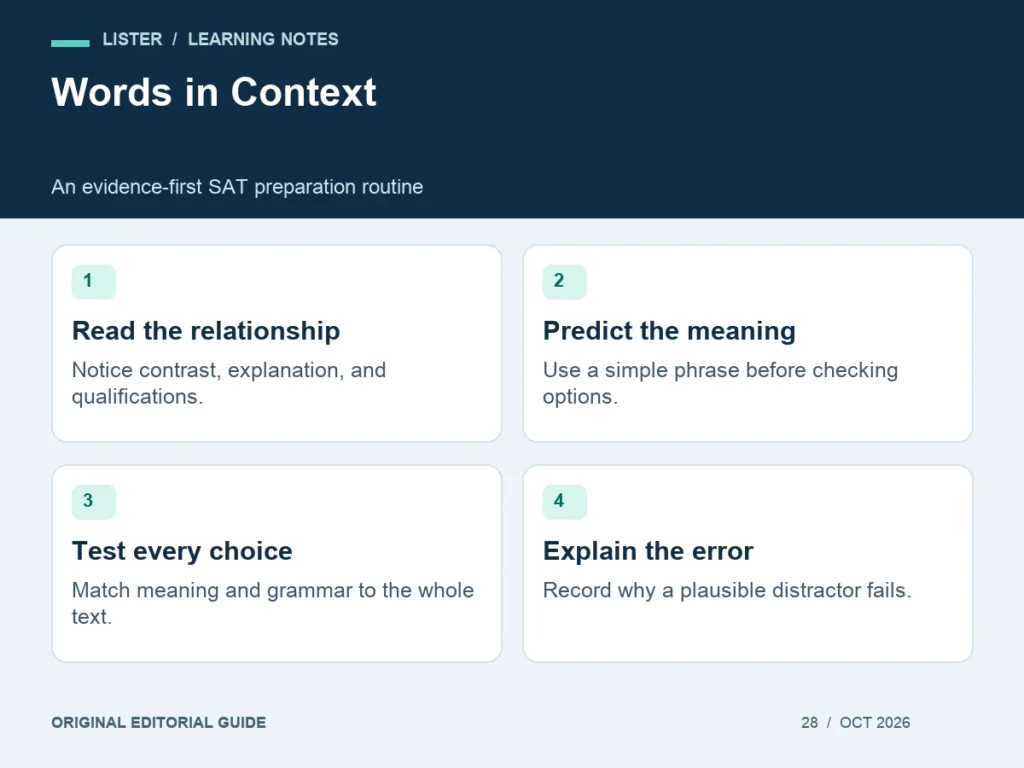
SAT preparation for Words in Context questions starts with reading the sentence as an argument, not as a vocabulary list. A familiar word can be wrong if it does not fit the author’s meaning. Use the surrounding information to predict the required meaning before comparing answer choices.
Where Words in Context fits
College Board places Words in Context within Craft and Structure in the Reading and Writing section. The examples below are original practice items. They illustrate reasoning strategies and are not official SAT questions or calibrated score predictors.
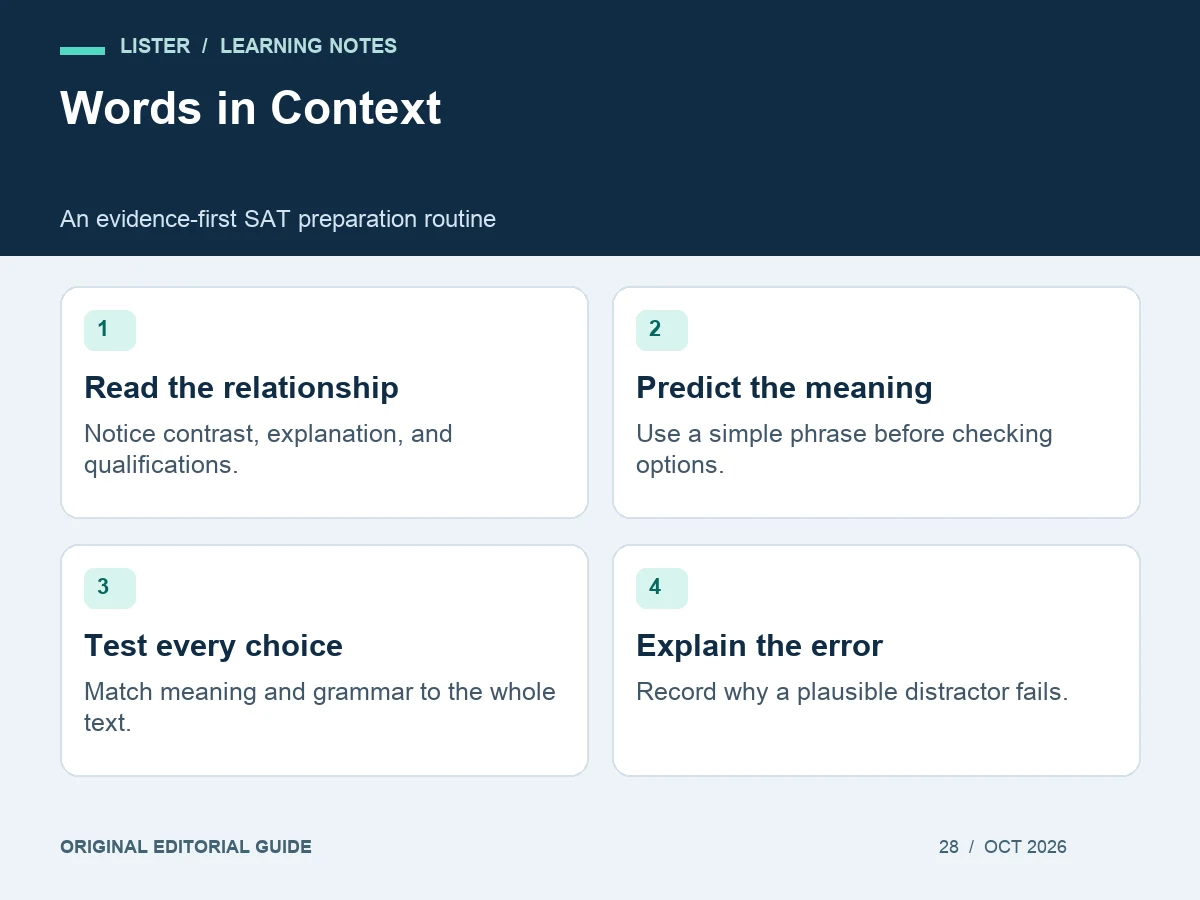
A four-step routine
- Read the whole text and identify the relationship between its ideas.
- Predict a simple meaning for the missing word.
- Check each option against that meaning and the sentence’s grammar.
- Reread the completed sentence to confirm that it preserves the intended claim.
Your prediction does not need to match the correct option exactly. A phrase such as “not final yet” may be enough to recognise the right word.
Example 1: a result that may change
The team described its estimate as _____ because additional measurements could substantially alter the result.
A. permanent B. provisional C. irrelevant D. exhaustive
Answer: B, provisional. The explanation after “because” indicates that the estimate is not final. “Permanent” conflicts with possible change. “Irrelevant” concerns importance to a topic, not certainty. “Exhaustive” suggests completeness, which the need for additional measurements does not support.
Example 2: evidence against an interpretation
Rather than supporting the proposed explanation, the newly discovered records _____ it by showing that the event occurred decades earlier.
A. undermine B. reproduce C. simplify D. anticipate
Answer: A, undermine. “Rather than supporting” signals a contrast. The records weaken the explanation. Do not choose “simplify” merely because an earlier date might make a story easier to tell; the text provides no such claim.
Example 3: the extent of a change
The revision was _____: it corrected two labels but left the structure and conclusions unchanged.
A. comprehensive B. minor C. accidental D. controversial
Answer: B, minor. The colon supplies the evidence: only two labels changed. “Comprehensive” is too broad. Neither intention nor disagreement is discussed, so “accidental” and “controversial” introduce unsupported meanings.
Example 4: replacing a word in context
In “The committee weighed the competing proposals before making its recommendation,” what does weighed most nearly mean?
A. measured their mass B. considered carefully C. transported D. reduced
Answer: B. The objects are proposals, and the purpose is to make a recommendation. The literal physical meaning does not fit. A word can have several meanings; the sentence determines which one is relevant.
Build an error log that improves your next attempt
Record the clue you missed, your prediction, and why your selected option failed. Useful labels include “missed contrast”, “ignored explanation”, and “chose a familiar meaning”. Then write a new sentence that uses the correct word with the same meaning.
Avoid treating every unfamiliar option as the answer. Learn vocabulary through examples, but keep returning to textual evidence. Successful practice means you can explain why an option fits and why a plausible alternative does not, even when the topic changes.
Continue learning
- SAT Preparation: A Practical Plan for International Students
- SAT Preparation: Transition Questions with Worked Examples
References checked: 28 October 2026.