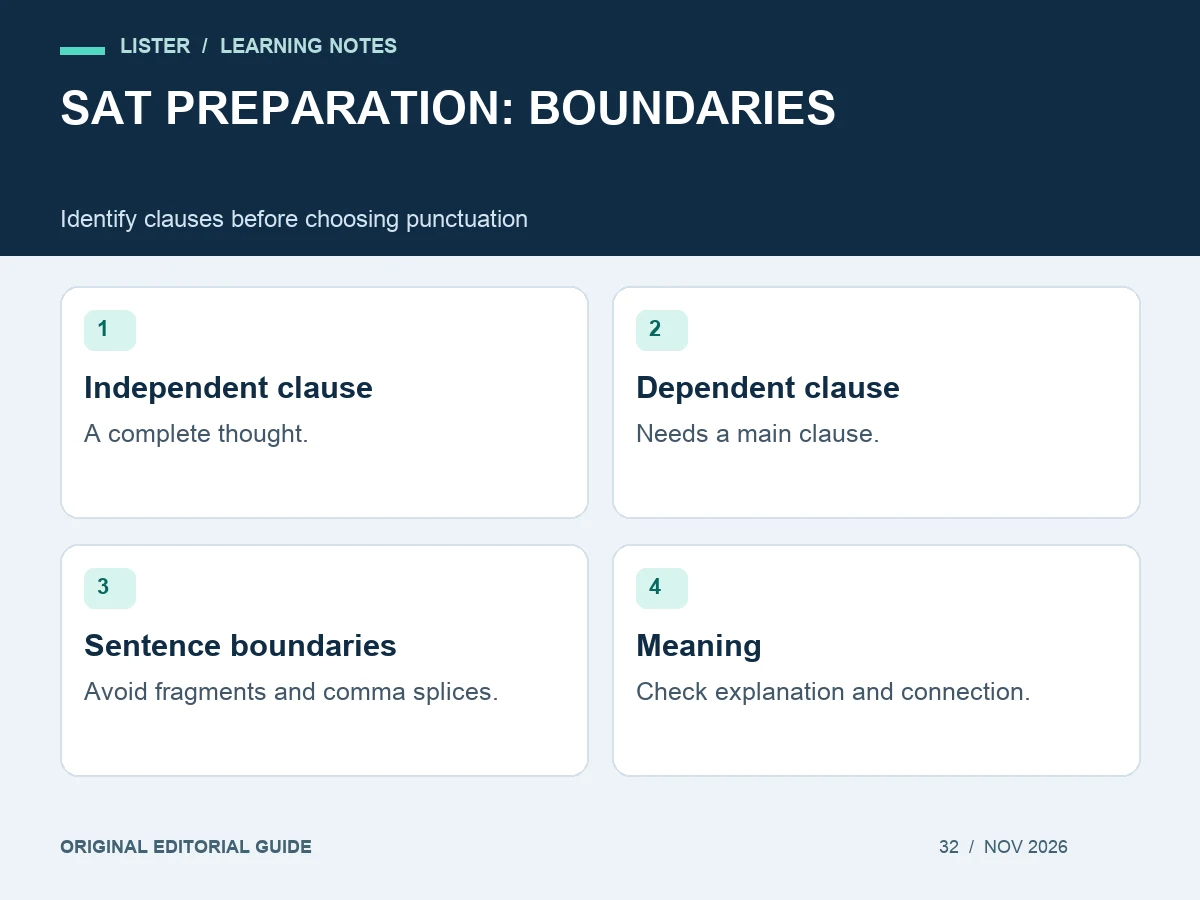
SAT preparation for Boundaries questions starts with identifying where clauses begin and end. These questions test whether punctuation joins or separates parts of a sentence appropriately. A long sentence does not automatically need more commas, and a pause in speech is not a reliable punctuation rule.
College Board places this work within Standard English Conventions. The examples below are original practice items, not official SAT questions.
Start with independent clauses
An independent clause can stand as a complete sentence. It normally contains a subject and a finite verb and expresses a complete thought. A dependent clause introduced by a word such as although cannot stand alone in the same way.
“The team revised the plan” is independent. “Although the team revised the plan” leaves the reader expecting another clause. Identifying that difference helps you evaluate punctuation before looking for familiar-looking answer choices.
Example 1: joining complete clauses
The archive opened a new reading room ___ researchers can now consult the collection on site.
A. ,
B. ;
C. : and
D. no punctuation
Answer: B. Both sides can stand as complete sentences. A semicolon can join them. A comma alone creates a comma splice, and no punctuation creates a fused sentence. The combination “: and” is not an appropriate connection here.
Example 2: an introductory dependent clause
Although the initial design was expensive ___ the team decided to build a small prototype.
A. ;
B. .
C. ,
D. :
Answer: C. The opening although clause is dependent and introduces the main clause. A comma marks that boundary. A period would leave the introductory clause as a fragment.
Example 3: a subject and its verb
The collection of letters from local residents ___ provides valuable evidence about the neighbourhood.
A. ,
B. ;
C. :
D. no punctuation
Answer: D. The complete subject is “The collection of letters from local residents”; its verb is “provides”. The length of the subject does not justify inserting punctuation between it and the verb.
Example 4: introducing an explanation
The committee had one practical concern ___ the room was too small for the expected audience.
A. :
B. ,
C. and
D. although
Answer: A. The words before the blank form a complete clause, and the following clause explains the concern. A colon can introduce that explanation. A comma alone cannot join these two independent clauses.
A repeatable checking process
- Read the whole sentence, including words after the blank.
- Locate the main subject and verb on each side.
- Decide whether each unit is independent or dependent.
- Check whether the second unit explains, contrasts with, or continues the first.
- Eliminate options that create fragments, comma splices, or broken grammatical units.
Meaning matters alongside grammar. For instance, a colon requires a complete clause before it and an appropriate explanatory relationship after it. Memorising “two clauses equals semicolon” without considering the available choices and context is not enough.
Use an error log
After practice, label each mistake: clause identification, subject–verb separation, introductory clause, or explanation. Rewrite the sentence correctly and explain the rule in one sentence. Then try a fresh item from the official Reading and Writing question bank. This makes your SAT preparation responsive to the errors you actually make.
Continue learning
- SAT Preparation: A Practical Plan for International Students
- SAT Preparation: Transition Questions with Worked Examples
References checked: 4 November 2026.