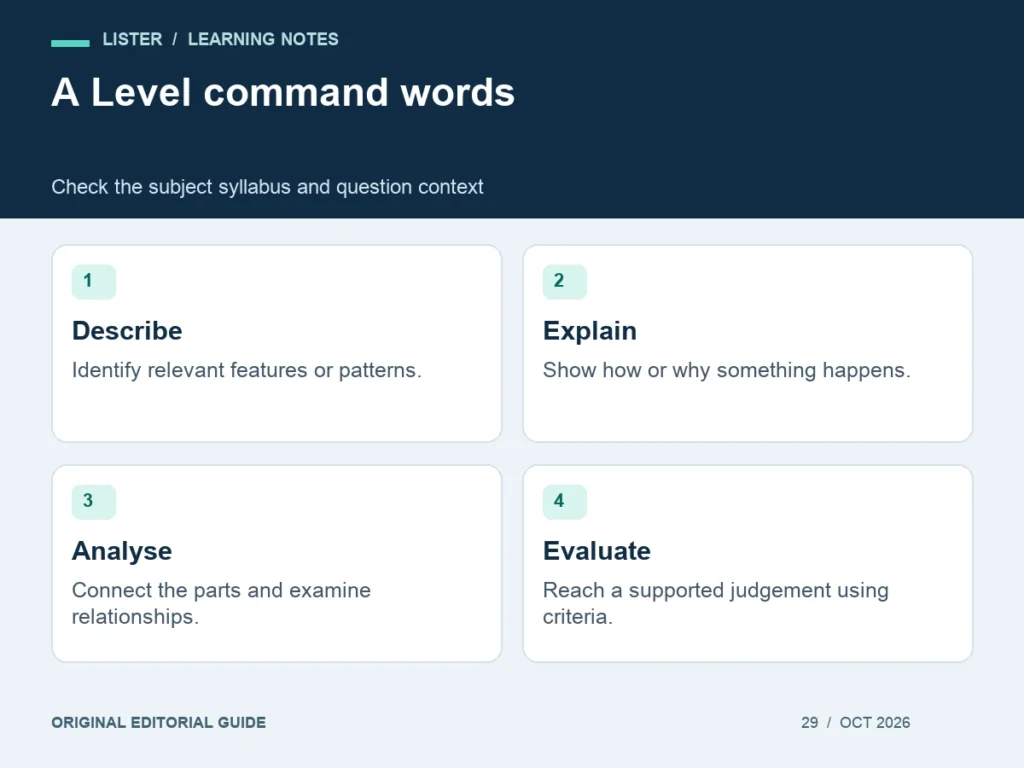
A Level command words tell you what kind of thinking a question requires. Knowing the topic is only part of answering well: describing a pattern, explaining a cause, analysing a relationship, and evaluating a proposal are different tasks. Use the command word to plan the response before you begin writing.
Scope: check your subject syllabus
Cambridge International’s command-word guidance provides a starting point, while subject syllabuses may give more specific meanings. This article uses Cambridge International AS & A Level as its context. Do not assume that every exam board, IB subject, or assignment uses identical definitions or marking expectations.
| Command | What your answer should do | Common gap |
|---|---|---|
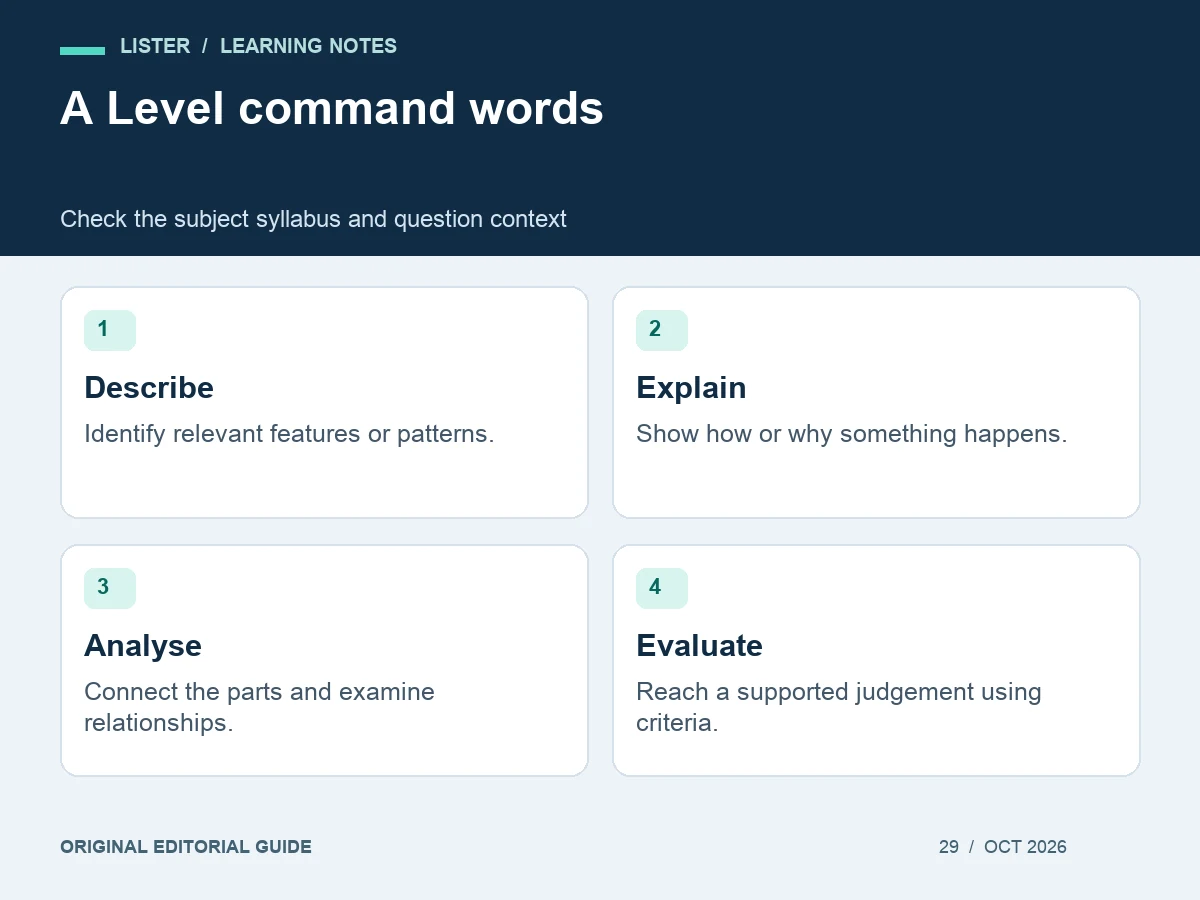
| Describe | Identify relevant features or patterns | Listing unrelated details |
| Explain | Show how or why something happens | Repeating the observation without a reason |
| Analyse | Examine parts and the relationships between them | Presenting facts without connecting them |
| Evaluate | Reach a supported judgement using relevant considerations | Giving an opinion without criteria or evidence |
One original scenario, four different responses
Imagine a school introduces a longer library opening period. During a four-week trial, recorded visits rise from 120 to 180 per week. The trial also overlaps with exam preparation. These figures are invented for learning and are not research findings.
Describe the change
“Recorded weekly visits increased from 120 to 180, a rise of 60 visits.” This identifies the observed change. It does not yet explain why it happened. If the question asks for a pattern, begin with what the data actually show.
Explain how longer opening could increase visits
“Longer opening may allow students with afternoon activities to visit later, increasing the number of opportunities to use the library.” This gives a possible mechanism. The wording remains cautious because the scenario does not establish the cause of every additional visit.
Analyse the relationship
“The increase is consistent with improved access, but exam preparation may also have raised demand. The opening period and seasonal study needs changed together, so the figures cannot isolate their individual effects.” This connects several elements rather than merely repeating the totals.
Evaluate whether the school should retain the change
“Keeping the longer hours may be worthwhile if the additional access justifies staffing costs. However, the school should examine use outside the exam period and ask which students benefit before making a permanent decision.” This reaches a conditional judgement and states the considerations behind it.
Why a longer answer is not automatically stronger
An extended description can still fail to explain. Likewise, listing advantages and disadvantages without a conclusion may leave an evaluation incomplete. Match the response to the command, subject content, evidence provided, and mark allocation. There is no universal rule that one paragraph or one point always earns a fixed number of marks.
A practical revision exercise
- Take a question from your current subject materials.
- Underline the command word and identify the content boundary.
- Write a one-sentence plan for the required thinking.
- Compare your answer with the relevant mark scheme and teacher feedback.
Keep a record of the mismatch, such as “described when asked to analyse”. This makes revision more precise than simply deciding to write more. Always return to your own syllabus and question context before applying a general framework.
Continue learning
- International Curriculum: Choosing Subjects for University
- International Curriculum: Making the IGCSE to A Level Transition
References checked: 28 October 2026.