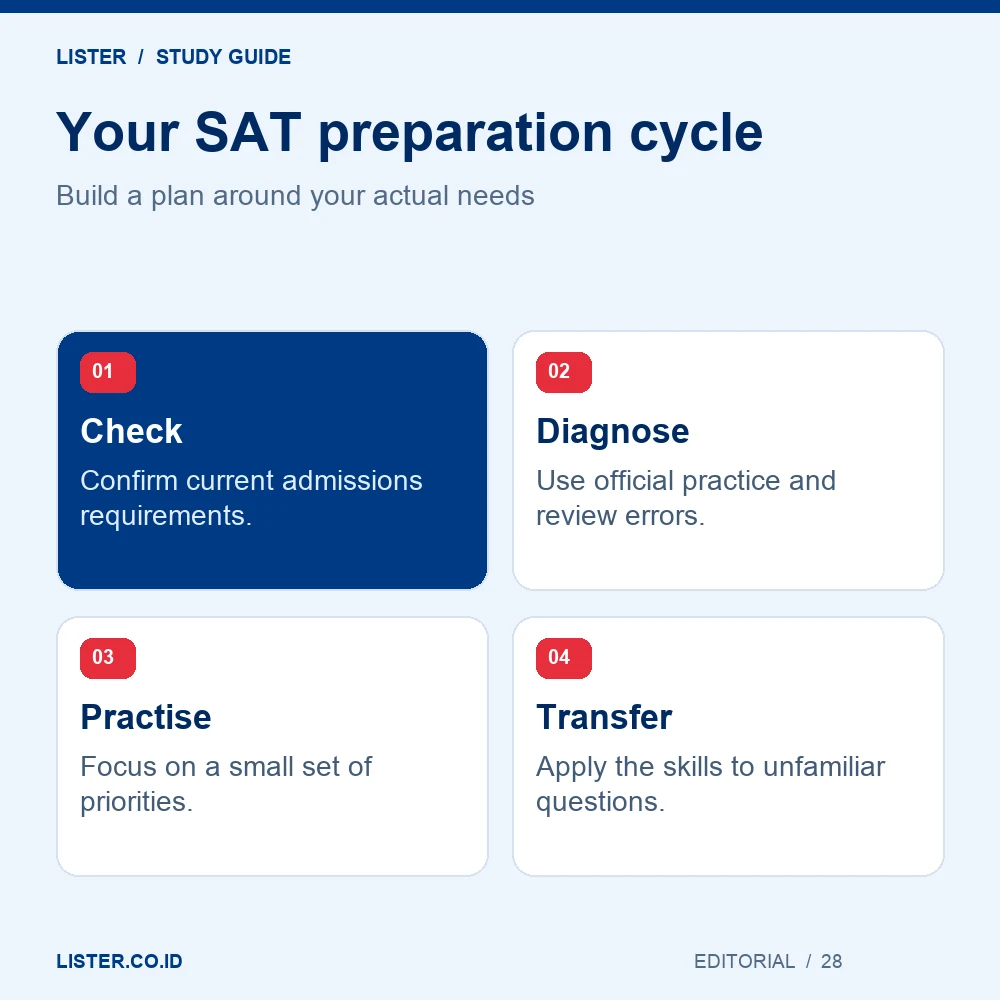
SAT preparation starts with a clear admissions requirement and an honest baseline. Before choosing a study schedule, check whether your intended universities require, consider, or do not use SAT scores for your application route. Policies can differ by institution, qualification, and entry year.
For international students, the challenge is often coordinating test preparation with school assessments, English-language requirements, and application deadlines. A useful plan connects these commitments instead of treating the SAT as an isolated project.
Start with a diagnostic, then choose priorities
Take an official digital practice test using the recommended setup. The SAT has Reading and Writing and Math sections, so record your performance in each rather than looking only at the total. Use College Board's official practice resources to begin.
Review every error by skill and cause. Did you misunderstand a concept, overlook a condition, lose track of time, or choose an answer without enough evidence? These causes call for different responses. A longer study session is not always the solution.
Build a weekly cycle you can sustain
Choose a small number of priorities for the week. Combine concept review, focused questions, and timed application. Reserve time to explain the answers: why the correct option works and why your original choice fails.
For example, a student who misreads graphs can practise checking units, axes, and the exact quantity requested. They should then apply the same checks to unfamiliar graphs. Repeating the original question tests memory more than transfer.
A sample six-week preparation framework
- Week 1: complete a diagnostic and confirm the relevant admissions deadlines.
- Week 2: repair the most important concept gaps identified in the diagnostic.
- Week 3: practise those skills in mixed questions and explain your reasoning.
- Week 4: apply timing while monitoring recurring errors.
- Week 5: take a fresh official practice test and adjust your priorities.
- Week 6: consolidate the remaining gaps and complete test-day preparation.
This is an organisational example, not a promise that six weeks is enough for every student. Extend or simplify the plan according to your starting point, school workload, and available test dates.
Prepare for the digital experience
Practise with the tools and navigation available in the official environment. Learn how to use the calculator when it helps, but keep checking whether your setup and reasoning are correct. A tool cannot resolve a misunderstood question.
Before test day, follow the official instructions for your device, identification, admission documents, and test centre. Online tutoring does not mean the official SAT can be taken informally from any location.
Keep score targets connected to your application
There is no universal SAT score that guarantees admission. Use the current policies of your intended programmes and consider the rest of your application. Also check English-language requirements separately; the SAT and an English proficiency test serve different purposes.
If you need help interpreting practice results or deciding what to study next, explore SAT preparation with Lister. Bring your diagnostic report and target programmes so the conversation can focus on the gaps that matter for your plan.